Self-Reported Data Is a Fraud Magnet. Here's What to Do Instead.

Jean Thirouin
Key Takeaway: Every campaign that relies on users to honestly report their status, history, or eligibility is leaking money to fraud. Checkboxes aren't verification. The fix is cryptographic proof that can't be faked.
You've seen this form a hundred times.
"Are you a current customer of [competitor]? Check here to claim your switching bonus."
"Select your income range to see personalized offers."
"What's your loyalty status with [partner]? Upload a screenshot for verification."
Every one of these is an invitation to lie.
Self-reported data is one of the most common ways brands try to qualify prospects, and one of the most easily gamed. The incentive to misrepresent is obvious: check the box, claim the bonus, disappear. The cost falls entirely on the brand.
The fraud you're not measuring
Most brands don't track fraud rates on self-reported eligibility claims. They know some percentage is fake, but they treat it as cost of doing business, baked into CAC assumptions.
This is a mistake. The fraud is bigger than you think, and it compounds.
When you offer a switching bonus to "competitor customers" based on a checkbox, you attract two audiences: actual competitor customers and people willing to check a box for free money. The second group converts at higher rates because they have nothing to lose. They're not actually switching. They're just claiming.
Your campaign metrics look fine. Conversion rate is healthy. CAC is within range. But your cohort quality is garbage. These "customers" churn immediately after the incentive period because they were never real customers to begin with.
The fraud isn't just the direct cost of the bonus. It's the distorted signal that makes your real metrics meaningless.
Why screenshots don't help
The obvious response is to require proof. Upload a screenshot of your competitor account. Send us a PDF of your statement. Email us your membership card.
This is better than a checkbox, but not by much.
Screenshots are trivially easy to fake. A few minutes in any image editor and you've got a "competitor account" with whatever status you want. PDFs can be modified. Documents can be fabricated.
Manual review catches some of this, but not reliably. Reviewers are looking at volume. They're not forensic analysts. Sophisticated fakes sail through.
And manual review creates its own problems: delays in the customer experience, operational costs that scale with campaign volume, and a bottleneck that limits how fast you can run acquisition.
The verification gap
Here's the core problem: self-reported data and document uploads both rely on trusting the user. Trust is the vulnerability that fraud exploits.
Real verification doesn't require trust. It requires proof.
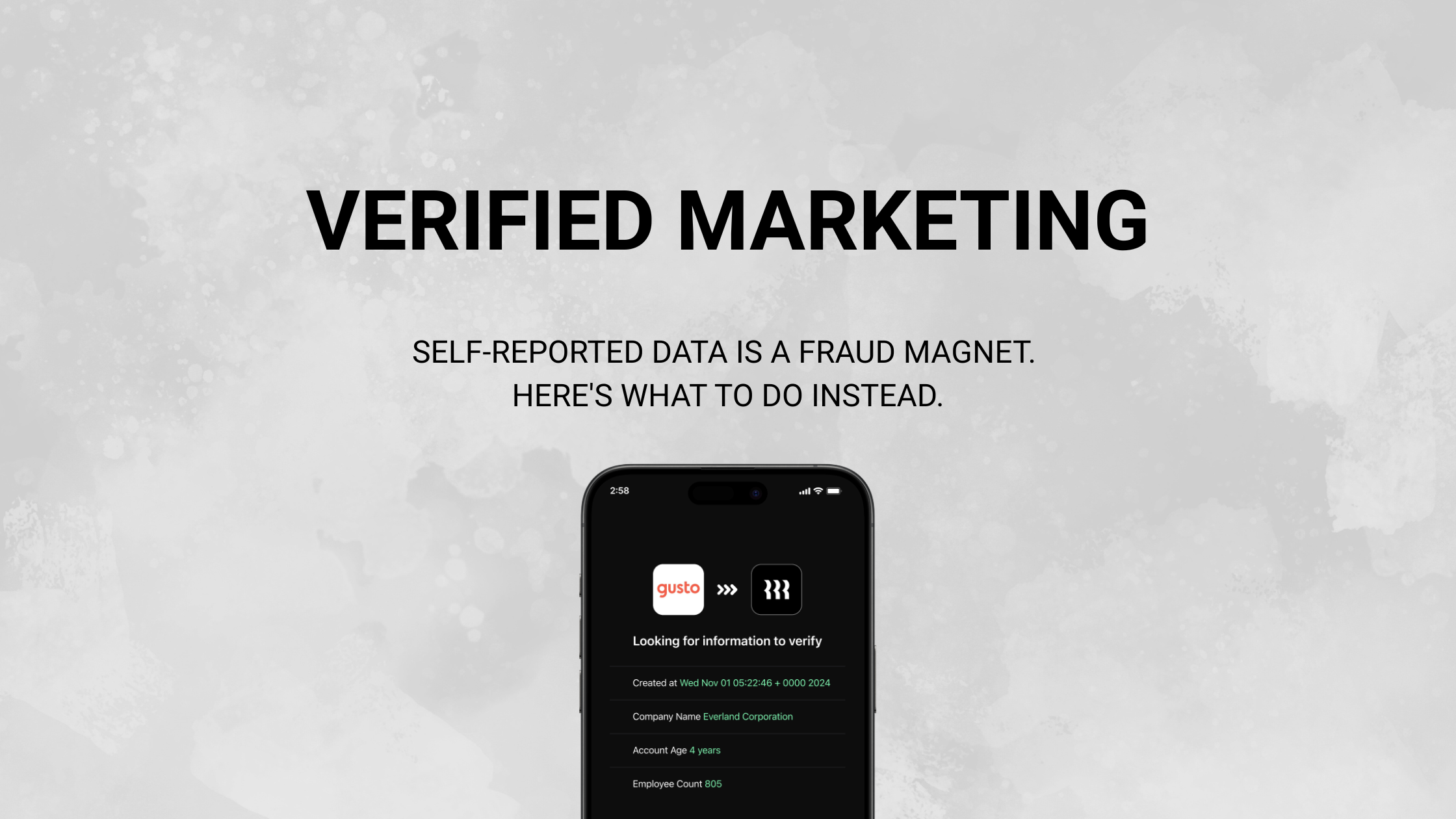
When a user logs into their actual competitor account and the verification confirms their status cryptographically, there's nothing to fake. They either have the account or they don't. They either have that status tier or they don't. The proof is mathematical, not visual.
This is the difference between asking someone to tell you something and confirming it at the source.
What real verification looks like
User claims they're a premium-tier customer at a competitor. Instead of uploading a screenshot, they authenticate directly with their competitor account through a verification flow.
The verification checks the actual account status. Not what the user says. Not what a document shows. What the competitor's own system says about this user.
The result comes back as a cryptographic proof: this user has an active account with premium status, verified directly from the source. It can't be faked because the user never controlled the verification. They just provided access to their own account.
Now you know the claim is real. You can offer the premium switching bonus with confidence. No fraud. No manual review. No delay.
The economics of trust vs. proof
Self-reported eligibility is cheap to implement. One form field, one checkbox, done.
But the hidden costs are substantial: fraudulent claims you pay out, cohort quality degradation you can't see until churn data comes in, distorted metrics that lead to bad decisions, and operational costs of manual review if you try to catch fakes.
Cryptographic verification has setup costs. You're implementing a real system, not adding a form field. But the ongoing economics are dramatically better: zero fraud, instant processing, and reliable data that actually means something.
The question isn't whether verification costs more upfront. It's whether you'd rather pay once to know for sure or keep paying forever for data you can't trust.
Checkboxes are easy. Proof is better.
Want to build verified engagement into your campaigns?
Whether you're launching reward programs, partnership campaigns, or dynamic incentive strategies, we can help you eliminate fraud and target with precision.
Schedule a demo or learn more at burnt.com.