The Document Is Dead: Why AI Has Made Traditional Verification Obsolete

Anthony Anzalone
When Seeing Is No Longer Believing
Something fundamental broke in 2024.
For decades, businesses relied on a simple assumption: if a document looked real, it probably was. A bank statement had watermarks. A paystub had the right formatting. An insurance card had a policy number. Manual reviewers could spot the forgeries—grainy scans, mismatched fonts, obvious Photoshop artifacts.
That world is gone.
Today, an AI can generate a pixel-perfect paystub in 30 seconds for less than the cost of a coffee. The watermarks are there. The formatting is flawless. The metadata checks out. It passes automated verification. It fools human reviewers. And it's completely fake.
Industry leaders aren't mincing words anymore. Allianz reported a 300% spike in AI-manipulated documents in claims processing. Lending platforms are seeing synthetic bank statements so convincing that only forensic analysis can catch them—and even that's becoming unreliable. We've reached a point where asking "does this document look authentic?" is the wrong question entirely.
The right question is: why are we still asking for documents at all?
The Verification Trap That's Costing You Twice
Most businesses don't realize they're paying for fraud twice.
First, there's the direct cost. Organizations lose an estimated 5% of annual revenue to fraud. For a mid-sized lender, that's millions vanishing into synthetic identities, forged income proofs, and fabricated employment records. Insurance carriers are approving fraudulent claims because the supporting documents pass every check.
But the second cost is worse: you're losing your legitimate customers.
Every time you ask someone to find their bank statement, download a PDF, scan it, and upload it to your platform, 40-60% of them just leave. They don't trust you with their sensitive data. They don't want to dig through email archives. They're on mobile and the whole process is a nightmare. Your conversion funnel has a massive leak, and it's happening at the exact moment when you're trying to verify someone's eligibility.
So you're stuck. Reduce friction and fraud spikes. Add more verification steps and legitimate users abandon. Document-based verification has become a trap where you lose either way.
Why We Built Infrastructure for Source Truth
We started BURNT because we kept seeing the same pattern across industries.
A fintech platform would build an amazing product, nail the user experience, get someone excited about a loan or insurance policy—and then hit them with: "Please upload your last two pay stubs." Drop-off would spike. The users who stayed would submit documents. Half would be legitimate. Half would be sophisticated forgeries that looked identical to the real ones.
The ops team would spend days reviewing. Manual review costs would balloon. Fraud would slip through anyway because the forgeries were getting too good. And the legitimate customers who made it through the process would leave reviews complaining about how long it took.
We realized the entire system was backwards. Instead of asking users to extract data from a source, submit it through an untrusted channel, and then having a business try to verify its authenticity after the fact, what if we could verify the data while it's still at the source?
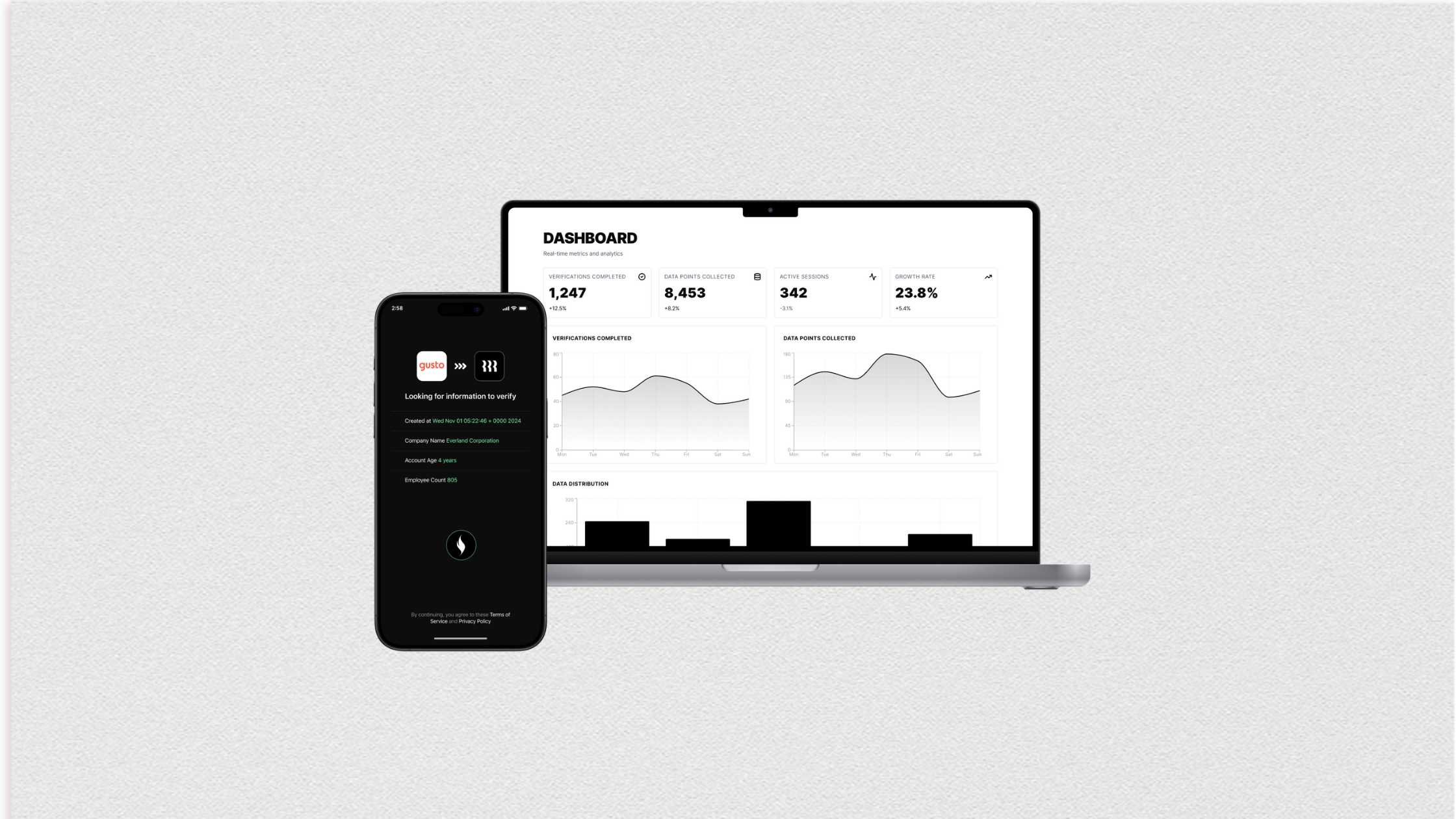
That insight led us to build verification infrastructure that works completely differently. When someone needs to prove their income, they don't download a document from their payroll provider. They log in directly. We verify the specific attribute needed—income above a threshold, employment status, payment history—and generate a cryptographic proof. The business gets a mathematically certain answer. The user's sensitive data never leaves their control. There's no document to forge.
From Guesswork to Mathematical Certainty
Most fraud prevention today is probabilistic. You feed a document into a system. Machine learning models analyze pixel patterns, metadata, compression artifacts. The system spits out a risk score: 73% likely authentic. Maybe you trust it. Maybe you escalate to manual review. Maybe you're wrong.
This worked when forgers were using Photoshop badly. It doesn't work when they're using AI that generates documents indistinguishable from originals.
Our infrastructure is deterministic. Not "probably real" or "likely authentic"—mathematically certain. When someone proves their credit score is above 700 by logging into Credit Karma, we're not guessing based on visual analysis. We're verifying the attribute directly from the authoritative source and generating a cryptographic proof that can't be forged, tampered with, or replicated.
The difference matters more than it sounds. With probabilistic detection, you're always playing catch-up. The fraudsters improve their techniques, you update your models, they adapt again. It's an arms race you can't win because you're fighting on their terms—trying to distinguish real documents from fake ones when both look identical.
With deterministic source verification, the document never enters the equation. There's nothing to forge. The proof comes directly from where the truth lives, wrapped in cryptography that makes manipulation mathematically impossible.
What Changes When Documents Disappear
We've seen what happens when businesses move from document-based verification to source verification. The changes show up faster than most expect.
Fraud collapses. When you remove the ability to submit manipulated documents, the attack vector disappears. We're seeing fraud rates drop from 15-20% to near zero. Not because the detection got better—because there's nothing left to fake. A fraudster can generate perfect synthetic paystubs all day long. They can't log into a real payroll account they don't have.
Conversion rates jump. The friction that was killing your funnel—the "find, download, scan, upload" nightmare—disappears. One-click login replaces a ten-minute document hunt. Users who would have abandoned stick around. We're seeing drop-off rates at verification steps fall by 70-80%. Your legitimate users actually make it through.
Processing time shrinks. Manual document review that took days or weeks becomes instant automated verification. Your ops team stops being a document review factory. Claims that sat in queues get resolved in seconds. Loan applications that needed human eyes to catch sophisticated forgeries get approved or denied immediately by automated logic.
Cost per account or claim drops. When you're not paying for manual review, third-party data pulls, and fraud losses, your unit economics change dramatically. Some of our early adopters are seeing 60-70% reductions in cost per acquisition because they're not burning money on reviewing forged documents and onboarding fraudulent users.
Liability disappears. When you never see or store the underlying sensitive data—just the verified attribute—your compliance burden and breach risk evaporate. No SSNs in your database. No bank statements on your servers. No PII to protect. Just cryptographic proofs of attributes you actually needed to verify.
The Path Forward
The fraudsters are already using AI. The question is whether your defense strategy is keeping pace.
If your verification process still involves asking users to submit documents, you're vulnerable. The forgeries are already indistinguishable from originals. Adding more sophisticated detection tools just delays the inevitable—you're fighting an arms race where the economics favor the attackers.
The businesses that win over the next few years will be the ones who recognize that the document era is over. Not because documents got slightly less reliable, but because AI made them completely untrustworthy as a verification medium. The organizations moving fastest aren't asking "how do we detect better fakes?" They're asking "how do we eliminate the document entirely?"
That's what we built BURNT to do. Not to make document review slightly better or fraud detection marginally more accurate, but to remove documents from the verification equation completely. To let users prove attributes directly from authoritative sources, with mathematical certainty and zero data exposure.
The infrastructure exists. The cryptography works. The verification happens in seconds, not days. Businesses using it are seeing fraud collapse and conversion jump simultaneously—solving both sides of the verification trap that's been destroying unit economics across lending, insurance, property management, and every other industry that relies on knowing something true about their users.
If you're a risk leader watching fraud losses climb, or an ops director drowning in document review backlogs, or a product team watching users abandon at the verification step, the path forward is clear. Stop trying to detect increasingly sophisticated forgeries. Start verifying directly from the source.
The document is dead. Source verification is how trust works now.
Want to build verified engagement into your campaigns?
Whether you're launching reward programs, partnership campaigns, or dynamic incentive strategies, we can help you eliminate fraud and target with precision.
Schedule a demo or learn more at burnt.com.